
There’s an old French proverb, popularised by Jean de La Fontaine: “never sell the bear’s skin before you have killed the beast.”
It’s really just the woodland version of not counting your chickens before they hatch. Don’t treat something that might happen as though it already has—especially when the bear has yet to be consulted in the matter.
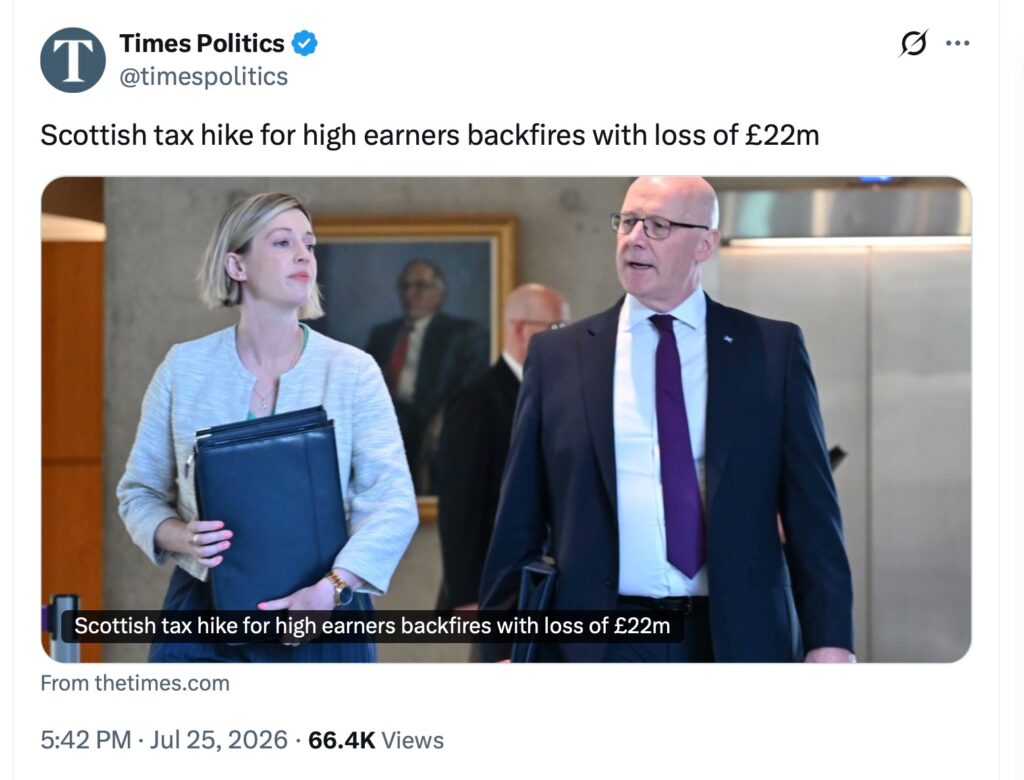
Which brings us neatly to The Times and this headline:
“Scottish tax hike for high earners backfires with loss of £22m.”
Well, there’s not much room for doubt there. Scotland increased its top rate of income tax and promptly lost £22 million. Cause established, case closed, bearskin folded and ready for collection.
There’s only one teensy weensy difficulty: HMRC reported no such loss.
Its figures show that Scotland raised £18.635 billion in income tax during 2024–25, an increase of 9% on the previous year. The number of top-rate taxpayers also rose from 35,400 to 41,400—an increase of 17%—while the revenue collected from income within the top-rate band increased from £1.876 billion to £2.069 billion.
That is £193 million quid more, not £22 million quid less.
So where did the headlined loss come from?
It came from interpreting a model produced by the tax expert Dan Neidle. His argument deserves to be taken seriously. He asks whether Scotland’s 48% top rate encouraged people to shelter more of their income through pensions, dividends and other perfectly legal arrangements. If it did, could a lower rate of tax have ended up collecting more?
It’s a reasonable question. The trouble begins when a question is headlined as a definitive answer.
To make his calculation, Neidle had to construct a Scotland that never existed: one in which the top rate remained at 45%. He assumed that, under that lower rate, the taxable incomes of established Scottish top-rate taxpayers would have grown at the same pace as those of comparable taxpayers elsewhere in the UK.
On that basis, another £336 million of taxable income would have appeared. Tax that larger, hypothetical sum at 45% and Scotland ‘might have’ collected £2.091 billion—£22 million more than the £2.069 billion actually collected at 48%.
And there it is. The famous £22 million.
It wasn’t discovered in HMRC’s accounts. It emerged only after £336 million of assumed additional income was inserted into a model of what ‘might have’ happened under a different tax rate.
That doesn’t make the exercise worthless. Higher taxes can alter behaviour. People may put more into pensions, take dividends instead of salary, postpone income, work fewer hours or move their tax residence. Any serious forecast must allow for those possibilities, and the Scottish Fiscal Commission does exactly that.
But a possibility is not a proven outcome.
People paying 45% can also use pensions, dividends and salary sacrifice. Scotland and the rest of the UK do not have identical economies or identical groups of high earners. London’s concentration of finance, corporate headquarters and very large bonuses makes it an imperfect comparison. Scotland’s different balance of oil and gas employment, public-sector work and taxpayers sitting just above the top-rate threshold may also help explain the figures.
Nor does the fall in the average amount paid by each Scottish top-rate taxpayer settle the matter.
Scotland gained 6,000 top-rate taxpayers in a single year. Many will have crossed only slightly above the frozen £125,140 threshold and will therefore have paid relatively modest amounts at 48%. Add enough people near the bottom of the group and the average payment falls, even while the total amount collected rises.
Neidle himself was considerably more careful than the newspaper headline:
“We can’t be sure, but the evidence we have is consistent with the 48p rate losing about £22 million of tax revenue for Scotland.”
The important words are “can’t be sure” and “consistent with”.
A wet pavement is consistent with rain. It is also consistent with a burst water main or a council cleaning vehicle. The wet pavement is an observed fact; the explanation still has to be established.
There is another simple way to examine the figures. Apply a 45% rate to the taxable income actually recorded in Scotland and it would have raised about £1.940 billion. The 48% rate collected £2.069 billion—approximately £129 million more. –
That in itself doesn’t prove the 48% wasn’t the better policy. Even at a lower rate, there’s nothing to prevent taxpayers being canny with their tax liability and being creative with legitimate tax avoidance. What it does show is that the supposed £22 million loss depends entirely on the assumption that a 45% rate would have produced another £336 million of taxable income.
Remove that assumption and the theoretical loss disappears.
There’s a perfectly proper debate to be had about Scotland’s tax system. It’s complicated, some marginal rates are uncomfortably high, and governments should care more about the amount collected than the moral satisfaction of announcing a higher percentage. It’s entirely possible that the final penny on Scotland’s top rate raises very little. It may even cost revenue after people change their behaviour. But “possible” remains the essential word.
The problem isn’t that Neidle asked the question. The problem is that The Times converted his conditional estimate into a categorical statement. “The evidence is consistent with a possible loss” became “Scotland lost £22 million”.
That is why we must read beyond headlines, however grand the masthead above them. We need to distinguish between what happened, what ‘might have’ happened and what a model suggests would have happened if all its assumptions were correct.
What factually happened is that Scottish income-tax receipts rose.
What might have happened under a different rate cannot be directly observed.
What the model produced was a theoretical difference of £22 million.
The policy remains open to argument. The certainty of the headline doesn’t.
The expert found tracks in the forest that could be a bear.
The Times sold the bearskin without killing ‘any’ beast.
